When dealing with plans everyday its useful to have a basic understanding of some of the acronyms that architects regularly use.
Councils also regularly get approached by new home owners wanting to find plans for their particular house often wanting to look into the structure of their house. Planning drawings are more focused on the external appearance of the building however the drawings for planning applications are often a pre cursor to the drawings submitted for building warrants which do contain structural information. Despite this plannig drawings usually contain codes that can provide home owners with further clarification.
I asked Chat GPT to go through and summarise what Acronyms we might come across and what they mean. See below
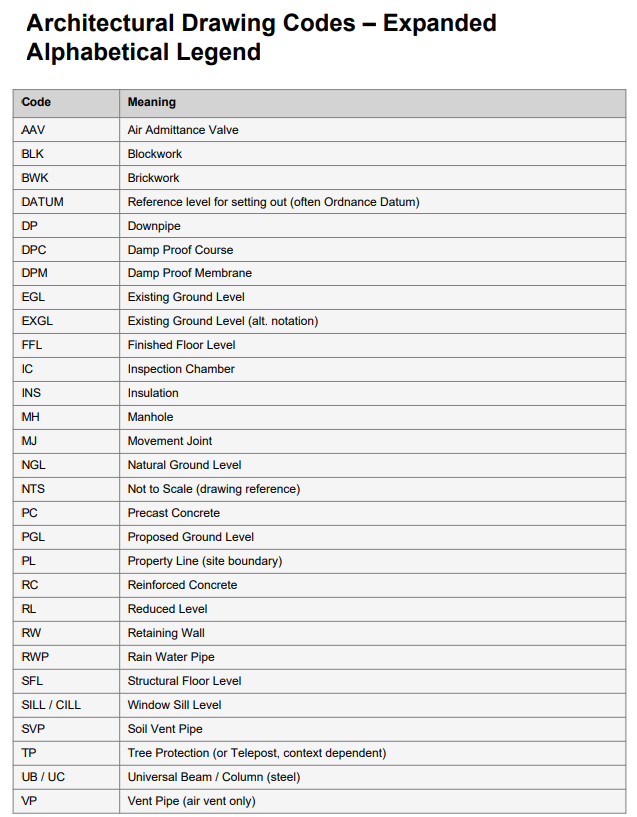
🚰 Drainage & Plumbing
These tend to appear around the edges of buildings or in service areas:
- RWP – Rain Water Pipe (the downpipe from roof gutters)
- SVP – Soil Vent Pipe (carries foul water and vents above the roof)
- VP – Vent Pipe (air vent only, no waste connection)
- AAV – Air Admittance Valve (a one-way vent instead of a roof vent)
- IC – Inspection Chamber (underground drainage access)
- MH – Manhole
🧱 Structure & Walls
These codes flag up constructional details and structural elements:
- MJ – Movement Joint (gap to absorb expansion/contraction)
- RW – Retaining Wall
- RC – Reinforced Concrete
- UB / UC – Universal Beam / Universal Column (steelwork)
- GL – Ground Level
🪟 Openings, Levels & Heights
Levels are crucial in planning drawings, as they show how the building sits in the landscape:
- FFL – Finished Floor Level
- SFL – Structural Floor Level
- CILL / SILL – Window sill level
- RL – Reduced Level (dimension relative to a datum)
🏗 General Building Elements
Often noted in section drawings and construction details:
- DP – Downpipe (sometimes used instead of RWP)
- BWK – Brickwork
- BLK – Blockwork
- INS – Insulation
- DPC – Damp Proof Course
- DPM – Damp Proof Membrane
- NGL – Natural Ground Level
- PGL – Proposed Ground Level
- EXGL – Existing Ground Level
🌍 Levels & Survey References
Survey information is usually tied to a known point or “datum”:
- DATUM – Reference level for setting out, often tied to Ordnance Datum
- EGL – Existing Ground Level
- RGL – Reduced Ground Level
Why it Matters
Planning drawings are mainly about showing external appearance, height, and relationship to the site, but they also carry just enough construction detail to keep the proposals clear. Knowing these abbreviations makes it easier to:
- Understand where water drains
- Spot important structural elements
- Read levels correctly
- Communicate confidently with architects, builders, or planning officers
Final Thoughts
Every architectural practice has its own quirks, but the codes above are some of the most common across the UK. Next time you’re poring over a set of drawings, keep this list handy and you’ll find the plans make a lot more sense.