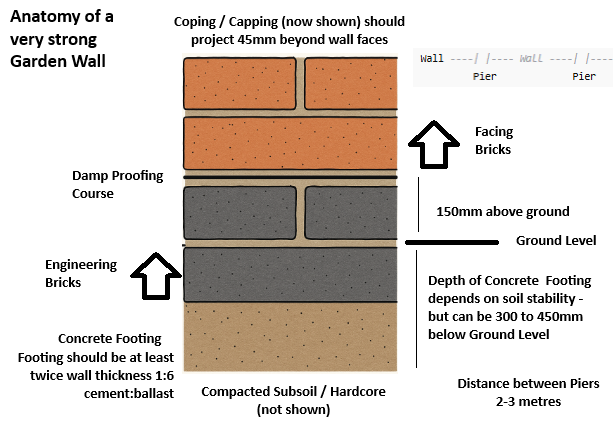
I was thinking about building a garden wall and did some investigations as to a solid construction. Here’s a diagram I put together with some notes on the composition. Note this is a consolidation of my online investigations. Similar construction would be suitable for an extension although that would involve further widening of the footing and blockwork on the inside tide to a concrete slab. I will do another post on foundations for your typical extension.
1. Foundation (Footing)
- Depth: At least 300–450 mm below ground level (deeper if soil is poor or prone to frost heave).
- Width: At least twice the wall thickness (e.g. a 215 mm wall should have ~450 mm foundation).
- Material: Concrete strip foundation (often 1:6 cement:ballast).
- Purpose: Spreads load, prevents settlement and tipping.
2. Damp Proof Course (DPC)
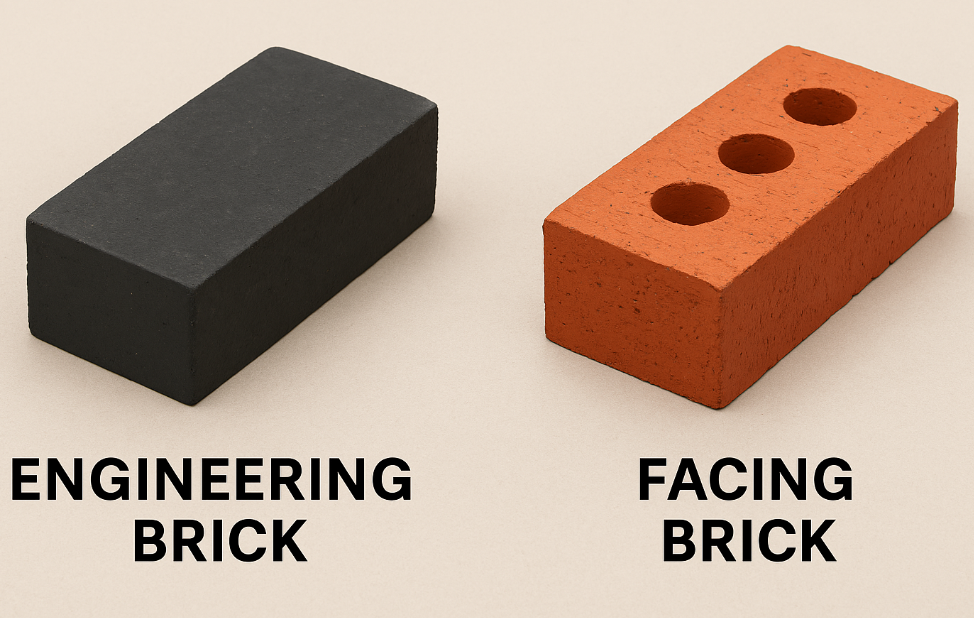
- A damp proof membrane or layer of engineering bricks placed 150 mm above ground.
- Prevents rising damp and frost damage to softer facing bricks.
3. Brickwork / Blockwork
- Single-skin half brick wall (102.5 mm thick): Weak, suitable only for low decorative walls.
- One brick thick wall (215 mm): Much stronger, suitable for higher freestanding walls.
- Bond: Use stretcher bond with piers or English/Flemish bond for strength.
- Engineering bricks recommended at base courses.
4. Piers (Buttresses / Pillars)
- Spaced every 2–3 metres along the wall for stability.
- Width: One brick square (215 × 215 mm) or more.
- Height: Same as wall, bonded into the brickwork.
- Purpose: Prevents bowing or collapse in wind loads.
5. Copings / Cappings
- A solid weathering detail at the top of the wall to shed rainwater.
- Options: Stone, concrete, or specially shaped coping bricks.
- Should project at least 45 mm beyond wall face with a drip groove underneath.
6. Drainage and Expansion
- For long runs, expansion joints may be needed every 6 m (brick) or 12 m (block).
- Drainage at base (weep holes) if wall retains soil.
And you have probably seen engineering bricks in the sides of buildings before but here’s a useful picture diagram